The right loan starts with the right question
"Personal loan" covers several quite different products in Singapore. Some give you a lump sum. Some give you a limit to draw on. Some exist only to clear debts you already have. Picking the wrong one can cost you more than picking the wrong lender.
This guide walks through the main types, what each is for, and who offers it, so you can start with the question that matters: what do I actually need this money to do?
Key takeaways
- A term loan gives you a fixed sum, repaid in equal monthly installments over a set period.
- A credit line gives you a limit to draw on. Flexible, but easy to stay in debt longer than planned.
- A balance transfer and a Debt Consolidation Plan (DCP) are for paying down debt you already have, not for new spending.
- Licensed moneylender loans are regulated by the Ministry of Law, with caps on interest and fees.
- Being able to borrow more doesn't mean you should borrow more. Choose the type that fits the need, not the biggest amount on offer. Loanify is a loan matching service, not a lender. Approval, contracts and disbursement are handled by the licensed moneylender you accept an offer from. Loanify is free for borrowers.
The main types at a glance
| Loan type | Best for | How you get the money | How you repay | Usually offered by |
| Term loan | A known, one-off cost | Lump sum | Fixed monthly installments over a set tenure | Banks, financial institutions, licensed moneylenders |
| Credit line | Irregular, short-term needs | Draw as needed, up to a limit | Interest only on what you use; minimum monthly payment | Banks and financial institutions |
| Balance transfer | Clearing credit card debt over a few months | Transferred to your existing balance | Pay down within the promo period, before the rate reverts | Banks and card issuers |
| Debt Consolidation Plan | Combining large unsecured debts into one repayment | Paid directly to your existing lenders | One fixed monthly installment | Participating banks and financial institutions |
| Licensed moneylender loan | Smaller, short-term needs, including when bank options are limited | Lump sum | Per the loan contract schedule | Licensed moneylenders |
Each type, explained
Term loan (personal installment loan)
You borrow a fixed amount and repay it in equal monthly installments over a set tenure. It's the most predictable option: you know from day one what you'll pay each month and when you'll be done.
It suits a cost you can name, like a wedding, a renovation top-up or a medical bill. Watch the Effective Interest Rate (EIR), not just the advertised rate, and check for processing fees.
Credit line
A credit line gives you a limit you can draw from whenever you need it. You pay interest only on the amount you use, but the rate is usually higher than a term loan.
The risk is that low minimum payments make it easy to carry a balance for years. A credit line works best for short, irregular gaps you'll clear quickly.
Balance transfer
A balance transfer moves debt, usually credit card debt, onto a short promotional plan at a low or 0% rate for a few months, typically with an upfront fee. If the balance isn't cleared by the end of the promo period, the remaining amount reverts to a much higher rate.
It can help if you have a clear plan to repay within the promo period. It doesn't help if you only make minimum payments.
Debt Consolidation Plan (DCP)
A DCP combines your interest-bearing unsecured debts across banks and financial institutions into one loan with one monthly installment. It's meant for people whose unsecured debt has grown large, typically more than 12 times their monthly income.
A few things to know:
- Your existing unsecured credit facilities are usually closed or suspended once the DCP is approved.
- Some loans are excluded, such as renovation, education, medical and business loans.
- You won't get spare cash from a DCP. It pays your existing lenders directly.
- Eligibility rules, including income ranges, vary by participating institution.
Licensed moneylender loan
Licensed moneylenders are regulated by the Ministry of Law, and their charges are capped by law:
| What's capped | Limit |
| Interest | 4% per month |
| Late interest | 4% per month, for each month repaid late |
| Late fee | S\$60 for each month of late repayment |
| Upfront admin fee | 10% of the principal |
| Total of interest, late interest and fees | No more than the principal |
The total you can borrow unsecured across all licensed moneylenders also depends on your annual income. For example, if you earn S$20,000 or more a year, the limit is 6 times your monthly income. For unsecured, non-business loans disbursed from 15 September 2026, there is also a three-business-day cooling-off period.
A licensed moneylender must explain your loan terms in a language you understand and give you a copy of the contract. They must never ask for your Singpass password, keep your NRIC, or approve a loan over phone, SMS or email without proper checks. You can verify any moneylender's license on the Registry of Moneylenders site.
This is the type of loan Loanify matches you for, through our partner network of licensed moneylenders.
Choosing by need
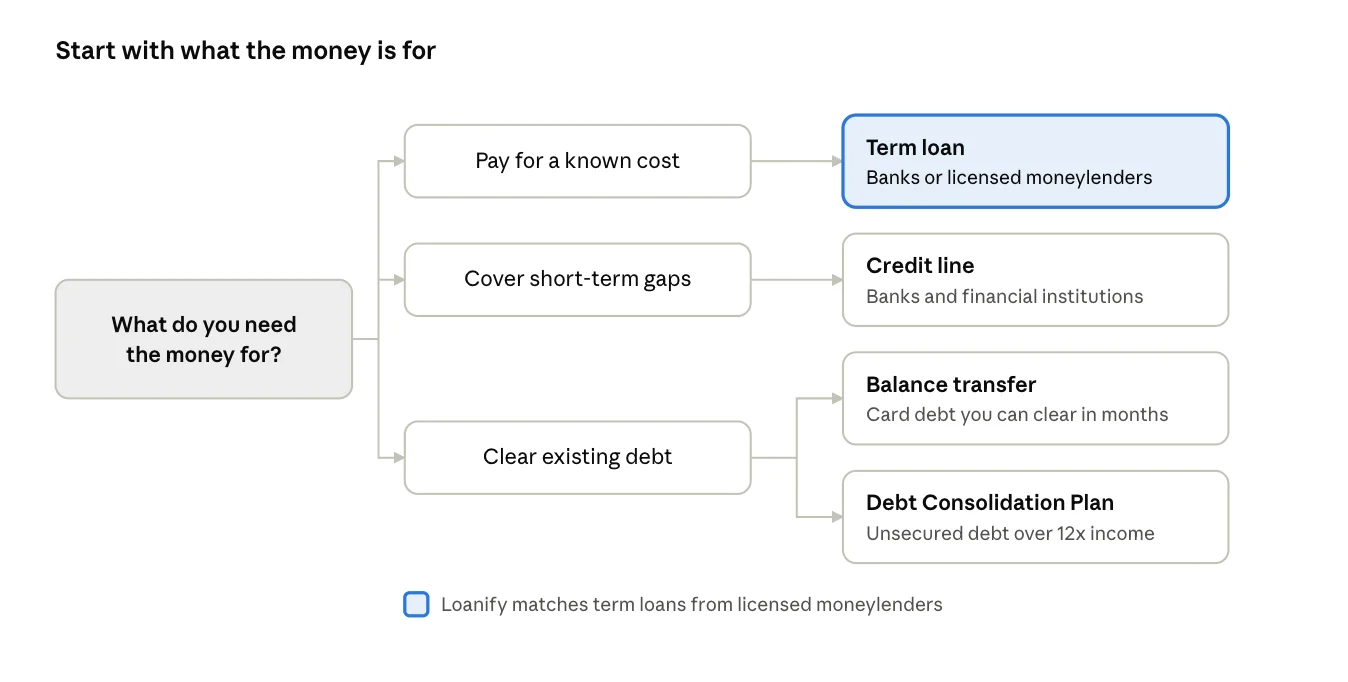
If you're clearing debt, a balance transfer suits smaller card balances you can repay within a few months. A DCP is for larger unsecured debt spread across several lenders.
What to check before you borrow
Whichever type you're considering, look at these before you sign:
- Effective Interest Rate (EIR). The true yearly cost once fees and the repayment schedule are counted.
- Total amount repayable. Principal plus all interest and fees.
- Monthly installment. It should fit your budget comfortably, alongside your other commitments.
- Fees. Admin or processing fees, late fees, and early repayment fees.
- What happens if you're late. Late interest and fees can add up quickly.
- The contract itself. Read the repayment schedule, interest rate and fees, and keep your copy. Being able to borrow more doesn't mean you should borrow more. Borrow for the need you have, at an amount you can repay without strain.
Frequently asked questions
What's the difference between a personal loan and a DCP?
A personal loan gives you cash to use for a purpose you choose. A DCP doesn't give you cash. It pays off your existing unsecured debts and replaces them with one installment.Is a balance transfer cheaper than a personal loan?
It can be, for a few months. But it only works if you clear the balance before the promo period ends. After that, the rate usually jumps.Can Loanify help me with a DCP or balance transfer?
Those are offered by banks and participating financial institutions, so we'd point you to them. Loanify matches you with licensed moneylenders in our partner network. If what you're looking for is a bank product, our team will let you know on the call so you know where to look.How much can I borrow from a licensed moneylender?
It depends on your annual income. If you earn S\$20,000 or more a year, the total you can borrow unsecured across all licensed moneylenders is capped at 6 times your monthly income. Lower limits apply to lower incomes.How do I know a moneylender is licensed?
Check the Ministry of Law's [Registry of Moneylenders](https://rom.mlaw.gov.sg/) site. A licensed moneylender will never ask for your Singpass password or keep your NRIC.Does Loanify charge me a fee?
No. Loanify is free for borrowers. We may receive a commission from our partner lenders.Not sure which type fits? Talk to a real person
Apply once with Singpass, and a real person from our team will reach out on WhatsApp to understand what you need. No obligation to accept any offer, and it's free for borrowers. Matched, not sold.
**Talk to our team **
Borrow only what you need and can comfortably repay. Compare the full cost of a loan, including fees and total interest, before accepting any offer.
Loanify is a loan matching service, not a lender. Loanify does not guarantee approval. Approval, loan contracts, interest rates, fees and disbursement are determined and handled by the licensed moneylender you accept an offer from. This article is general information and should not be treated as personalised financial advice. Questions? Email contact@loanify.sg or call +65 6041 4104. Loanify Pte. Ltd. (UEN 202523130E).
[reviews]
[contact]
[contact-form]
Sources
